Kitturu Fort:
Photo Gallery:
Photos: Naveen- Belgaum
Information Courtesy: Wikipedia

Parasgad Fort is a ruined hill fort in the Belgaum district of Karnataka state, India. magnificent fort of Parashghad, dating back to the 10th century and built by famous rulers of Ratta dynasty Parasgad Fort is located about two kilometres south of Saundatti village, and stands on the south-west edge of a range of hills immediately overlooking the black soil plain down below.
The hill which measures about 500 metres (1,640 ft) from north to south and about 300 metres (984 ft) from east to west, is irregular, and a good deal is covered with prickly pear and brushwood. Its sides are rocky and almost perpendicular. A deep gorge runs through it.
Atop the hill-fort is a small ruined shrine to the Hindu deity Maruthi. The fort itself is uninhabited, and the remains of old houses are located in it.
A descent of several hundred steps leads to Yadravi village. This passes by a natural spring with a water tank measuring thirty by six metres called the Ramatheertha, and a cave housing statues of Hindu deities and mythological figures including Jamadagni, Parashurama, Rama, and Sita, a Shivalinga with a Nandi. The village of Yadravi is referred to as "Elarame" in an inscription found on a platform near the Bharamappa temple of the village. The inscription is dated Shaka 901 in the Hindu calendar.
Photo Gallery:

Courtesy: Wikipedia

Navilatirtha (also written Navilateertha, Naviltirth) it a well-known picnic spot, in Belgaum District, North Karnataka in Karnataka, near Saundatti, on the Renuka sagara (Renuka lake), which is on the Malaprabha river.
At Saundatti there is the famous Renuka (Yallamma) temple at Yallammagudda.
Mahatapasvi Shri Kumarswamiji
Navilatirtha is said to be where Gurudeva Mahatapasvi Shri Kumarswamiji meditated in 1932.
Kundalini was awakened as the result of worship of the Devi, Mahatapasvi Shri Kumarswamiji, at the age of 18. He had remarkable spiritual experiences. Another significant stage in his spiritual development was the 'attainment of the siddhi of levitation during his yogic practices at Navilateertha on the banks of Malaprabha River, he attained oneness with ruler of Time and Space.
Photo Gallery:.jpg)

Courtesy: Wikipedia

Hooli is in Belagavi / Belgaum District in North Karnataka India. It is about 9 km from Saundatti.
Introduction
Hooli has so many temples, every temple has its own well. Even at remotest location on the hills has couple of temples.One of the oldest village in the Belgaum District, it is famous for Panchaligeswara temple. some of the other ruined temples waiting for conservation and restoration.
On the outskirts of Hooli the is Trikuteshwara Temple.
Hooli Temples
Panchalingeshwara temple HooliA nice architecture of Hooli Panchalingeshwar Temple to be adored. It is a protected monument comes under Archeological Survey of India. Earlier people during summer afternoon they used to resting in the shade of this temple. Because of the temple made of stone, was unbelievably cool even in the scorching summer.
Conservation and Restoration
Other than Panchalingeshwara Temple Hooli has many other old temples, most of them are now in ruins due to negligence. One can amazed by the sculptures and carvings on the stone. Most of the temples have their floor dug up for the hunt for treasure so much is lost and stolen.- Andhakeshwara Temple
- Bhavnisankara Temple
- Kalmeshwara Temple
- Kashi Vishwanatha Temple
- Madaneshwara Temple
- Suryanarayan Temple
- Tarkeshwara Temple
- Hooli sangameshwar ajjanavaru Temple its great god of hooli
- Beerdevar temple Hooli
Above mention temple are in need of Conservation and Restoration.
Shivakashi Stream
Shivakashi Valley seems to be a place which was once densely covered by trees. At this location you can find the marks left by monsoon springs and water falls. Based on stories I heard from my grandma and others village elders there used to be tigers once upon a time. Stories were told to me where some village folks hunted them off decades ago.
The location otherwise is dotted with few temples and well. Tigers may have disappeared, but you will still be lucky to find the black face monkeys eating the figs from those few remaining trees.
Photo Gallery:


Courtesy: Wikipedia

Sogal is a place in Belgaum district, Karnataka, India. The place name is ascribed to a sage, Sugola Muni, who is believed to have lived in the area, but one inscription speaks of "Sovala." Located on a hillside, Sogal has many temples, including the Someshwara temple and is of great antiquarian interest.
Local folklore states that tigers came to Sogal to listen to the religious teachings. Other legends include a nearby Kalyanmantapa (temple), now renovated, where the marriage of Shiva and Parvati is said to have taken place. There is an old statue of Panchanana Shiva and Parvati, Shiva with basinga and other traditional ornaments. There are Ashtadikpalakas (statues of gods) in this area, such as; Yama, Agni, Ishanya and Indra — and these artifacts are examples of the artistic accomplishments of the period.
On the hill to the east of Sogal is an old fortification, now in ruins, locally referred to as Kadambarayan Kote — perhaps named after Kadamba King. To the east of this temple is the Ajjappana Gudi and a stone Surya-Chandra shrine also here. Near the Someshwara temple there is also small shrine called Girija Temple, but the building is in a dilapidated condition.
Photo Gallery:
Courtesy: Wikipedia
Saundatti (kannada ಸವದತ್ತಿ )(also known as Sugandavarti and Savadatti) is one of the oldest towns in Belgaum district in the south Indian state of Karnataka. It is a celebrated pilgrimage centre located 78 kilometres from Belgaum. Saundatti is taluk headquarter of same name. Previously Saundatti taluk was known as Parasgad. There are several ancient temples in Saudatti.
History
The historical name of the Savadatti (Saundatti) was Sugandavarti. It was the capital of Ratta dynasty (During 875-1230), later shifted to Belgaum.
- In 12th - 13th centuries, Belagaon (Belgaum) was the capital of Rattas, the chieftains of Saundatti. Belgaum fort was built by Bichiraja (Ratta Dynasty) in 1204.
- Rashtrakuta or their relatives shaped several kingdoms, Ratta dynasty is one among them.
- Rattas of Saundatti accepted the overlordship of Taila II (A.D. 973-977).
- At Belgaum fort, Two of its pillars have Kannada Inscriptions in Nagari Scripts, one inscription of 1199 belongs to Ratta King Kartaveerya IV.
The Rattas (Rashtrakutas) of Saundatti
- In one of the inscriptions related to Rattas of Saundatti it is mentioned that Krishna III having appointed Prithvirama as a chief feudatory had dignified the Ratta dynasty of Saundatti.
- The rattas of the saundatti, who were used to represent themselves as lords of the Lattaluru (present day Latur), could have represented their ancestor as Manyakheta pua var adhisvara if they wanted to avoid Lattalura pura var adhisvara.
Inscriptions
of Krishna Rashtrakuta, Shaka 797(c. 875 A.D), and Vikramaditya, Shaka 1017 (c. 1095 A.D).
- At Saundatti, in front of the Western Chalukya style Ankeshwara temple, there is an inscription carved into the wall by the Ratta Chief Ankarasa.
Jainism
- Rattas of Savadatti are Jains by religion.
- In 11th century A.D. Rattas of Saundatti and their provincial governors were great patrons
of Jainism.Kartivirya's son, a Jain saint Munichandra a minister to Laksmideva and a teacher, and has the title of Acarya, the founder of Ratta-rajya.
- Savadatti has 2 small Jain basadis of Ratta times.
Tourism
Savadatti fort18th Century Savadatti fort was built by the Sirasangi Desai with 8 bastions. Savadatti fort has a Kadasiddheshwara temple, surrounded by four bastions. Around the Kadasiddheshwara temple in the inner chajja of the prakara there is a row of beautiful carvings of geometrical patterns with over two hundred designs, some painted.
Renuka Sagara
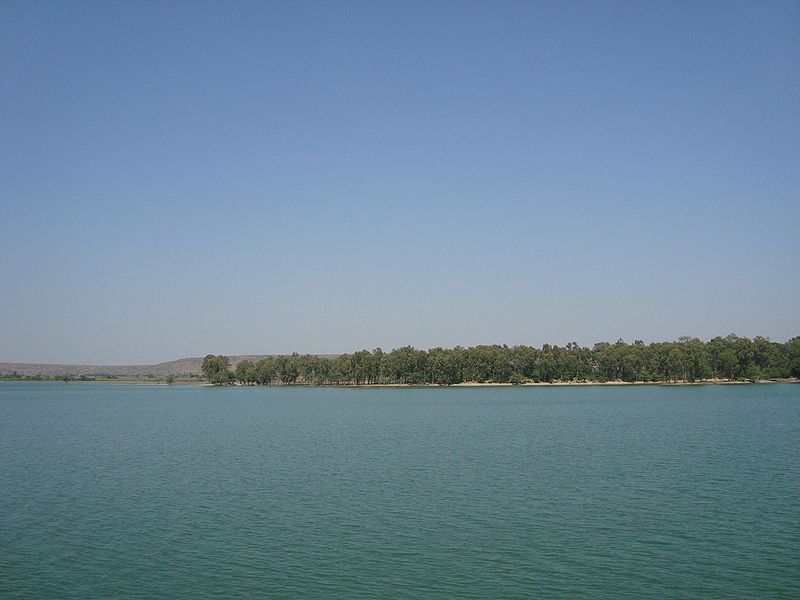
Renuka sagara is a reservoir for the Malaprabha River adjacent to Saundatti, formed by the Navilatirtha Dam. The name Renuka sagar because of the famous Renuka (Yallamma) temple Yallammagudda Saundatti.
Yallammagudda
The temple of Goddess Yellamma is a popular pilgrimage site for Shakti devotees. Every day, hundreds of pilgrims visit the temple with great devotion. The congregation is especially large, crossing the ten lakh mark on two auspicious days Banada Hunime and Bharathi Hunime. The century-old temple of Yellamma is situated atop Yellamagudda, amidst picturesque Ramalinga Hills about 5 km from Savadatti. Between Savadatti and the temple is the magnificent fort of Parashghad, dating back to the 10th century.
Navilatirtha
The Renukasagara, formed by the Navilatirtha Dam touches the low-lying areas of Saundatti. There is a spot called Jogulabhavi here, where there is a temple. Pilgrims take a holy dip here before visiting the Yellamma Hill. This Samādhi is in the area called Ramapur at Saundatti, which is humming with religious activities.
Savadatti Temples
The town has temples dedicated to Ankeshwara, Puradeshwara, Nagarkere Mallikarjuna, Veerabhadra, Ulvi Basavaeshwara, Mouneshwara, Dyamavva and Venkateshwara, which is the largest.
Puradeshwara temple
The Puradeshwara temple in the later Chalukya style is a trikutachala with three ardhamantapas, a common navaranga and two mukhamantapas.gurlhosur chidambar temple is also thair a hiatorical temple, All three garbhagrihas with pierced windows have shivalingas. The shikhara, now damaged, over the central garbhagriha is in Kadambanagara style and the navaranga pillars are lathe-turned. Inside the niches of the navaranga are images of Parvati and Veerabhadra. This temple has been renovated very crudely. On the day of Ugadi, the rising sun's rays fall directly on the main shivalinga. The outer walls have fine sculptures depicting Hndu mythology and there are inclined chajjas all round. The open mukhamantapa, a later addition, is also in the same style with massive pillars.
Ankeshwara temple
The Ankeshwara temple in Desaigalli, built by Rattas in 1048 is in the Western Chalukya style and is below the ground level. There are steps descending to the mukhamantapa. In front of the temple, there is an inscription carved into the wall by the builder, Ratta Chief Ankarasa.
Photo Gallery:
Savadatti Fort
Naviluteertha
Renuka SagaraCourtesy: Wikipedia
Vajrapoha Falls is a waterfall situated amidst hilly surroundings of the Jamboti forest. It is situated near Khanapur which is in Belgaum district. This place is 26 kms from Belgaum.
It can be reached from Jamboti up to a point four km beyond Chapoli and then cross the river (only in December and January) Mahadayi twice (in between is a small hill) finally leading to an elevated flat hillock. Here the river Mahadayi flowing in a serpentine fashion takes a first jump from a height of about 60 meters
Courtesy: Wikipedia
Information Courtesy: Wikipedia
Commutation
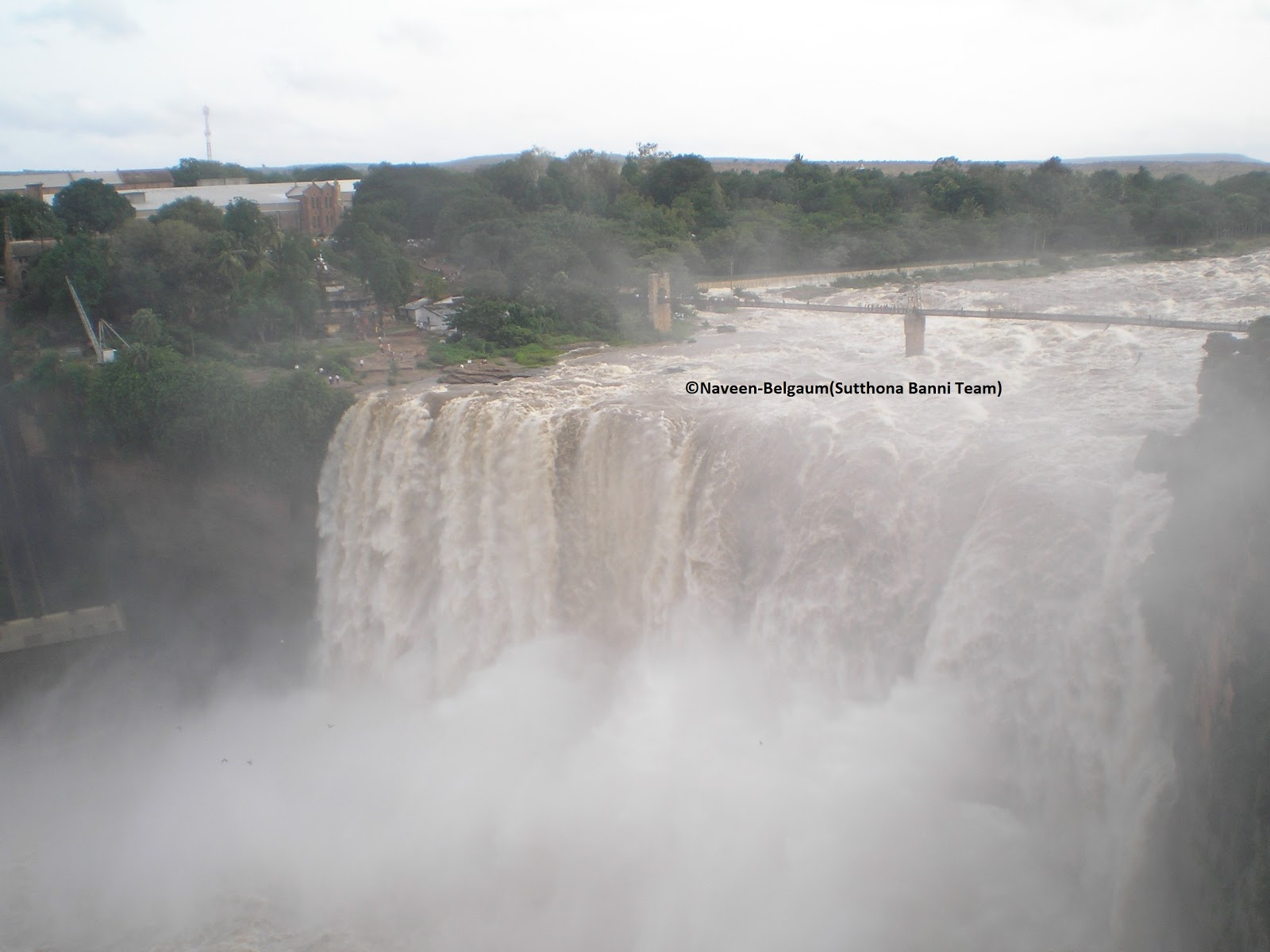
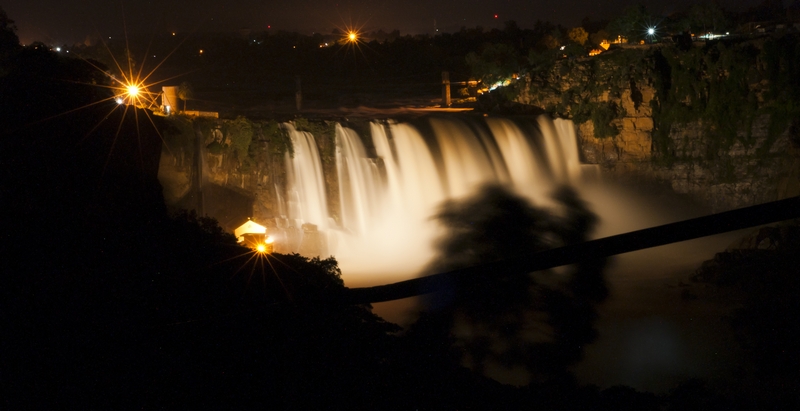
Distance from Belgaum : 65 kmDistance from Gokak : 6 km
The best time to visit Gokak falls is around July - October.
It experiences moderate climate throughout the year, however the nights are too cool and days are warm.
Photo Gallery:
Information Courtesy: Wikipedia